
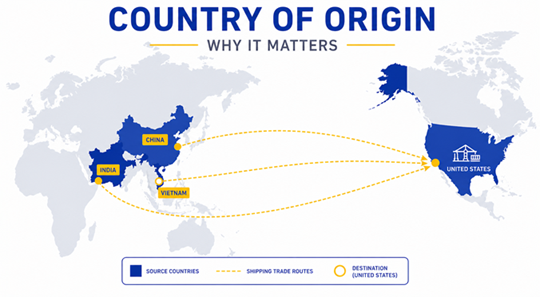
Many importers assume that where a product ships from is where it’s “from.” That assumption is wrong, and in 2026, it’s an expensive one that can lead to fines and legal liabilities.
Country of origin is the legal determination of where a product was made. Not where it was shipped from, not where the exporting company is registered, and not where it was packaged. It’s determined by US Customs and Border Protection (CBP), and it controls which tariffs apply to every shipment that crosses the US border.
If you’ve moved production from China to Vietnam to reduce your tariff exposure, country of origin rules determine whether that move actually worked. If you’re importing products that contain steel, aluminum, or other metals, origin rules affect which Section 232 rate you pay. And if the new Section 301 tariff orders come through later this year, country of origin will become even more consequential than it already is.
This guide explains how origin is determined, why it matters across multiple tariff programs, and what you need to do to get it right.
For a full overview of the tariff programs referenced in this post, see our guide US Import Tariffs: A Complete Guide for Importers (2026).
What Country of Origin Actually Means
US customs law recognizes two ways a product can be considered to originate in a country.
The first is wholly obtained: the product was entirely grown, mined, or produced in one country with no foreign inputs. Agricultural commodities and raw materials typically fall into this category.
The second, and far more common for manufactured goods, is substantial transformation: the product was made using inputs from multiple countries, but underwent a manufacturing process in one country significant enough that it became a new and different article of commerce.
Most physical goods that US importers are sourcing fall into the second category. Which means the question isn’t simply where the factory is located, it’s whether what happens in that factory constitutes substantial transformation under CBP’s standards.
Country of origin also matters beyond tariffs. It affects eligibility for trade preference programs, compliance with country of origin labeling (COOL) requirements on consumer goods, import quota calculations, and government procurement rules. But for most importers in 2026, tariff exposure is the primary concern.
The Substantial Transformation Test
CBP uses a three-part test to evaluate substantial transformation. A product is considered substantially transformed if it emerges from a manufacturing process with a new name, a new character, and a new use compared to its inputs.
This sounds straightforward. In practice, it requires judgment, and CBP applies it as a totality-of-the-circumstances assessment rather than a rigid checklist. Here’s what each element means:
Name refers to whether the finished product is known by a different commercial name than its inputs. Raw cotton yarn is not a t-shirt. Steel coil is not a filing cabinet. This part of the test is usually the easiest to satisfy.
Character refers to the physical properties of the finished product compared to its inputs. A woven textile has different physical characteristics than the yarns it’s made from. An assembled motor has different characteristics than its component parts. Character is satisfied when the manufacturing process meaningfully changes the physical form of the inputs.
Use refers to whether the finished product serves a different commercial purpose than its inputs. This is often the most important factor. Inputs that have no independent commercial use except to become part of the finished good generally support a finding of substantial transformation.
Three examples illustrate how this works in practice:
Example 1: Passes. A Vietnamese factory receives raw fabric rolls from China, cuts them to pattern, sews them into finished garments, and adds buttons and labels. The finished garment has a different name (garment, not fabric), different character (wearable, structured), and a different use (consumer apparel vs. industrial textile). This is substantial transformation. The garment is Vietnamese-origin.
Example 2: Fails. A Chinese manufacturer produces fully assembled electronic components and ships them to a Vietnamese facility, where workers insert them into a housing, attach a label, and box the product for export. The Vietnamese operation adds minimal value and changes nothing about the fundamental article. This is not substantial transformation. The product remains Chinese-origin.
Example 3: Gray area. A Vietnamese factory performs genuine assembly operations on a product, but the primary functional components – motors, circuit boards, key structural parts – are sourced from China and account for the majority of the product’s value. CBP may find that the essential character of the product was already determined before it reached Vietnam. This is where classification rulings become critical.
This gray area catches many importers who have shifted factories without fully analyzing their supply chains. Moving your final assembly to Vietnam does not automatically change your country of origin if your key inputs are still Chinese-origin. CBP looks at the totality of the manufacturing process, including where the value was created and where the essential character of the product was determined.
If you’re shifting production to reduce Section 301 exposure, the first question to answer is whether your new manufacturing location genuinely transforms the product, or whether the substantive work is still happening upstream in China.
Why Country of Origin Matters So Much in 2026
Section 301 and the Transshipment Problem
Section 301 tariffs are triggered by Chinese origin, not by Chinese shipping. A product that was manufactured in China and routed through Vietnam before entering the US is still Chinese-origin if no substantial transformation occurred in Vietnam. CBP is well aware of this practice, and transshipment – using a third country as a pass-through to avoid duties – is treated as customs fraud. Penalties include cargo seizure, significant fines, and in serious cases, criminal liability.
This isn’t a theoretical risk. CBP has increased enforcement resources specifically targeting transshipment schemes, and suppliers in Southeast Asia who offer to “re-export” Chinese goods under their own origin documentation are creating legal liability for the US importers who receive those shipments.
For another type of customs fraud on CBP’s radar, check out our Is DDP Shipping Legal? post.
The Coming Section 301 Expansion
Section 301 tariffs have historically applied to goods from China. That may be changing.
When the Supreme Court struck down the IEEPA tariffs in February 2026, the administration moved quickly to replace them. Section 122 was invoked as a short-term bridge, providing a 10% global surcharge while longer-term alternatives are developed. The stated plan is to replace the IEEPA tariff structure with new Section 301 and Section 232 tariffs, which carry more durable legal authority.
On March 11, 2026, USTR initiated formal trade investigations into the manufacturing practices of 16 countries, including Vietnam, India, Cambodia, Thailand, Indonesia, South Korea, Taiwan, the EU, Japan, and others, covering 86 countries in total. These investigations are the procedural foundation for new Section 301 tariff orders.
Unlike Section 122, which applies a flat 10% to all countries, Section 301 tariffs are country-specific and product-specific. If enacted, rates will vary by trading partner, likely mirroring the country-specific IEEPA rates that were previously in effect. That means a product made in Vietnam could face a materially different rate than the same product made in India or Cambodia.
Hearings were scheduled for May 2026. Tariff orders could follow later this year.
The practical implication is significant: importers who shifted sourcing from China to Vietnam or other Southeast Asian countries to reduce tariff exposure should not assume that exposure is permanently gone. The tariff landscape for alternative sourcing countries is in flux, and country of origin will determine your exposure under whatever new Section 301 structure eventually takes effect.
For a full breakdown of how to evaluate and select a sourcing country, see our Complete Guide to Sourcing from Asia.
Section 232 and the Origin of Inputs
For products subject to Section 232 tariffs on steel, aluminum, or copper, country of origin matters at the input level, not just the finished good level.
A product manufactured using metal that was melted, poured, or smelted entirely in the United States qualifies for a 10% tariff rate, versus 25% or 50% for the same product using foreign-sourced metal. Claiming this lower rate requires documentation of your manufacturer’s metal supply chain, not just where the finished product was assembled.
For the full breakdown of Section 232 rates and the April 2026 changes, see our April 2026 Update to Section 232 Tariffs on Steel, Aluminum, and Copper.
Anti-Dumping and Countervailing Duties
When importers look up what they’ll pay in tariffs, they typically account for their base duty rate, Section 122 (global 10%), Section 301 (currently for China-origin only), and Section 232 (steel, aluminum, and copper). There is a fourth layer that catches many importers off guard: anti-dumping duties (AD) and countervailing duties (CVD).
Anti-dumping duties are imposed when a foreign manufacturer sells goods in the US at prices below what they charge in their home market, or below the actual cost of production. Countervailing duties are imposed to offset subsidies provided by foreign governments to their domestic producers – grants, tax breaks, below-market loans, and other advantages that give those producers an unfair cost advantage in the US market.
Both types of duties are administered jointly by the Department of Commerce, which investigates whether dumping or subsidization is occurring and calculates the applicable rates, and the US International Trade Commission, which determines whether the US domestic industry has been materially injured. Both agencies must make affirmative findings for an order to be issued.
There are several things about AD/CVD that distinguish them from other tariff programs:
The rates can be severe. AD and CVD rates range from 5% to over 500%. They stack on top of Section 122, Section 301, and Section 232, which means a product subject to multiple programs can face a combined duty rate that makes importation economically unviable.
They are product-specific and producer-specific. Unlike the broad tariff programs, AD/CVD orders target a specific product from a specific country, and rates vary by individual exporter. Two factories in the same country producing the same product can have dramatically different AD rates based on their own pricing and cost data.
They are not included in standard tariff calculators. Because rates are so product-specific and producer-specific, general duty calculators don’t capture them. You have to check separately.
Rates are reviewed annually and can change retroactively. This is the detail most importers don’t know until it affects them. Even after your goods have cleared customs, your final AD/CVD assessment can be revised through the annual administrative review process, resulting in an additional bill months after importation.
As of early 2026, there are over 600 active AD/CVD orders in effect. Steel and aluminum account for more than 150 of them. China is the most frequently targeted country, but India, South Korea, Vietnam, and others are subject to significant orders as well.
The connection to country of origin is direct. AD/CVD orders are country-specific, which is precisely why CBP watches transshipment so closely. Routing goods through a third country to avoid an AD/CVD order carries the same legal risk as routing them to avoid Section 301.
High-risk product categories where you should check for AD/CVD exposure before placing any significant order: steel and aluminum products, solar panels, furniture, tires, lumber, shrimp and seafood, ceramics, and industrial chemicals.
Unfortunately, there is no quick and easy way to search for all current AD/CVD orders and rates.
The best place to start is the trade.gov databases at https://access.trade.gov/adcvd and https://beta.trade.gov/adcvd-search
If you think your product may be subject to AD/CVD rates, it is best to work with a customs broker or trade professional to confirm before importing.
How to Get It Right
Before you import
Map your full supply chain. Know where your raw materials come from, where each manufacturing step takes place, and what percentage of the product’s value is created at each stage. This is the foundational work that makes everything else possible.
Check CBP classification rulings. The rulings database at rulings.cbp.gov contains CBP’s past determinations on how specific products have been classified and where they originate. If someone has already imported something similar to your product and CBP ruled on its origin, that ruling is a strong signal of how CBP would view yours.
Check for active AD/CVD orders. Before placing a large order, search usitc.gov for active orders on your product and exporting country. Get the rate for your specific supplier, not just the country average — the difference can be substantial.
Consider a binding ruling for high-stakes imports. If you’re moving significant volume and genuinely uncertain about your origin determination, CBP offers binding ruling requests. The process takes time, but the ruling gives you legal certainty before you commit to large orders or restructure your supply chain.
Common mistakes that create real liability
Taking your supplier’s certificate of origin at face value without understanding their upstream supply chain is one of the most common errors in importing. A certificate is only as reliable as the documentation behind it, and your supplier’s incentive is to sell you product, not to protect your customs compliance.
Moving production to a new country without confirming that genuine substantial transformation occurs there is another frequent problem. Many importers discover after the fact that the process they moved doesn’t meet CBP’s standards.
And assuming that Vietnam, India, or other alternative sourcing countries are permanently tariff-safe is a significant planning risk given the ongoing Section 301 investigations. Build flexibility into your supplier relationships so you can respond if rates change.
Frequently Asked Questions
If my product is assembled in Vietnam using Chinese parts, what is its country of origin?
It depends on what happens in Vietnam. If the Vietnamese manufacturing process substantially transforms the Chinese inputs into a new article of commerce with a different name, character, and use, the product is Vietnamese-origin. If the Vietnamese operation is primarily final assembly or packaging with no meaningful transformation, CBP will likely consider the product Chinese-origin. The specific facts of your manufacturing process and the value and nature of the Chinese inputs both matter.
What's the difference between anti-dumping and countervailing duties?
Anti-dumping duties are imposed when a foreign company sells goods in the US below fair market value. Countervailing duties are imposed when a foreign government subsidizes its domestic producers in ways that give them an unfair cost advantage. Both can apply to the same product at the same time, and both stack on top of other applicable tariffs.
How do I check if my product has an active AD/CVD order?
Search the databases at https://access.trade.gov/adcvd and https://beta.trade.gov/adcvd-search. Search by your HTS code, product description, and country of export. If you find an active order, identify the rate for your specific exporter or producer, since rates vary significantly between companies.
Will Vietnam face new Section 301 tariffs in 2026?
Vietnam is included in the Section 301 investigations USTR initiated in March 2026. Whether and at what rate tariffs are ultimately imposed will depend on the outcome of those proceedings, including the public comment period and hearings scheduled for May 2026. No orders have been issued as of the publication date of this post. We will update this section as the situation develops.
Need Help Navigating This?
Country of origin rules, Section 301 exposure, and AD/CVD orders interact in ways that are genuinely complex and have real financial consequences. Getting it right requires knowing not just where your product ships from, but how every layer of US trade law applies to your specific product and supply chain.
First Link works across Vietnam, India, China, and Southeast Asia to structure supply chains that are compliant, cost-efficient, and built to adapt as the tariff environment continues to evolve. If you’re rethinking your sourcing strategy in light of the current trade landscape, we’d be glad to talk.
This post is part of our guide US Import Tariffs: A Complete Guide for Importers (2026).