
When the Supreme Court struck down the IEEPA tariffs in February 2026, a lot of importers assumed their China duty burden had dropped significantly. For most, it hadn’t.
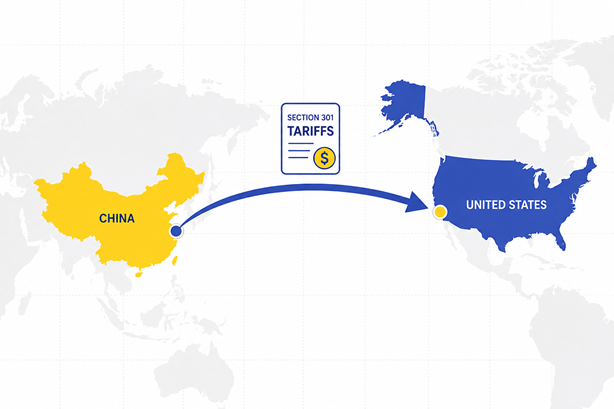
Section 301 tariffs were completely untouched by that ruling. They existed long before IEEPA, they survived every legal challenge thrown at them, and they remain the dominant cost driver for anyone importing goods from China. Understanding how they work, what they cover, and where they’re headed is essential for any importer making sourcing decisions in 2026.
For a full overview of how the US tariff system works and how these programs interact, see our US Import Tariffs: A Complete Guide for Importers (2026).
What Section 301 Is and Where It Came From
Section 301 gets its name from Section 301 of the Trade Act of 1974, which gives the US Trade Representative (USTR) broad authority to investigate and respond to foreign trade practices that are unfair, unreasonable, or discriminatory toward US businesses.
The investigation that led to today’s tariffs was launched in August 2017. After a seven-month review, USTR concluded that China’s trade practices – specifically around forced technology transfer, intellectual property theft, and restricted market access for US companies – caused significant harm to American commerce. That finding authorized the tariff actions that followed.
Tariffs were imposed in four waves between July 2018 and September 2019, covering approximately $370 billion in annual Chinese imports across four product lists. Unlike the IEEPA tariffs that came later, Section 301 has a durable legal foundation. The Federal Circuit upheld the validity of Lists 3 and 4A in September 2025, closing the door on the most significant legal challenge the program has faced. These tariffs have no expiration date and do not require congressional renewal to stay in effect.
That’s the key distinction heading into 2026. The tariff programs that got struck down were built on IEEPA authority. Section 301 is built on entirely different legal ground, and it isn’t going anywhere.
What Section 301 Covers and How to Find Your Rate
Section 301 tariffs are organized into four product lists, each created at a different point between 2018 and 2019 and covering different categories of Chinese goods at different rates. Lists 1 and 2 focus primarily on industrial goods and components and carry a 25% rate. List 3 is the broadest, covering a wide range of manufactured consumer and commercial goods, also at 25%. List 4A, which was partially rolled back as part of the Phase One trade deal in 2020, covers consumer staples, apparel, and footwear at 7.5%.
On top of these base rates, the Biden administration’s 2024 statutory review elevated rates significantly on a handful of strategic product categories like electric vehicles, solar panels, semiconductors, and a few others.
The practical question for most importers isn’t which list they’re on, it’s what rate applies to their specific product. The fastest way to find out is to go to the official Section 301 Tariff Page and enter your 8-digit HTS code into the Section 301 lookup tool. It will tell you the HTS code description and the Section 301 tariff rate. Remember that this rate may stack with other tariffs and is not necessarily the final rate you will pay.
If you don’t yet have your HTS code, see our guide How to Find Your HS Code for US Imports.
How Section 301 Stacks With Other Tariffs
Section 301 is one of multiple tariffs that can apply to Chinese-origin goods. When calculating your landed costs, you need to make sure you’re taking all applicable tariffs into account.
The base rate is first. This is the standard duty rate for your product that applies to imports from any country, determined by your HTS code. Rates vary widely: electronics often sit at 0%, apparel can run 16–32%, and everything in between.
Section 301 is added on top of the base rate. Depending on your product and which list it falls under, that’s an additional 7.5% or 25% for most goods.
Section 122 is added on top of that. That’s the current 10% applied globally to all countries.
If your product involves steel, aluminum, or copper, Section 232 may stack on as well. And if there’s an active anti-dumping or countervailing duty order on your product, that adds another layer still. For a full breakdown of how AD/CVD duties work and how to check whether they apply to you, see our post What Is Country of Origin? A US Importer’s Guide.
A relatively simple example may involve a product with a 5% base rate, a 25% Section 301 rate and the 10% from Section 122, for a combined rate of 40% before any other fees. On a $10,000 shipment, that’s $4,000 in duties at the port.
To run the full numbers on your own product, use our Landed Cost Calculator.
A Word on DDP Shipping
One practice worth flagging which has become increasingly common since the first trade war and accelerated significantly after the 2025 IEEPA tariffs: some Chinese suppliers offer DDP (Delivery Duty Paid) terms at prices that seem surprisingly low given current tariff rates. The way those numbers work is often that the supplier is under-reporting the customs value of the shipment to CBP. Lower declared value means lower duties.
While the lower costs seem attractive, this practice amounts to customs fraud. If a shipment like this is caught by CBP, they don’t have jurisdiction to go after the foreign supplier. Instead, they go after the first involved party in the US. That’s you, the importer (even if you aren’t officially the Importer of Record, which you won’t be on a DDP shipment). Penalties can include back duties, fines, and in serious cases criminal liability. If a supplier’s landed price doesn’t add up given what you know about current tariff rates, you should stop and ask for more information.
For more on this, see our post Is DDP Shipping Legal?
Coming in 2026: 301 Tariffs on Other Countries
When the Supreme Court struck down the IEEPA tariffs in February 2026, it didn’t end the administration’s ambition to maintain elevated tariff levels on imports from China and other countries.
The administration plans to rebuild that tariff structure using Section 301 and Section 232 authority, which rests on firmer legal ground and has already survived multiple legal challenges. Section 122, the 10% global tariff, is functioning as a bridge in the meantime.
On March 11, 2026, USTR initiated new Section 301 investigations into a large number of countries including main trading partners like China, Vietnam, India, the EU, and Mexico. For China specifically, the investigations may mean even higher rates. For the other countries, it will most likely mean a return to rates similar to before the Supreme Court struck down the IEEPA tariffs in early 2026.
Treasury Secretary Bessent has indicated that by August, tariff levels are expected to return to roughly where they were before the Supreme Court ruling. The practical implication for importers is significant. If you’re currently modeling your sourcing costs at today’s rates, you may be underestimating what you’ll actually pay in Q4 2026 and beyond.
What This Means for Your Sourcing Strategy
Section 301 tariffs have been reshaping how US importers think about China for years now, and the trajectory isn’t changing. Here’s how to think about your options in the current environment.
Sourcing diversification is still the most effective long-term strategy. Moving production to Vietnam, India, Cambodia, or other Southeast Asian countries removes Section 301 exposure on your goods for now, and will likely result in lower rates even if Section 301 tariffs are placed on other countries later this year.
For a full breakdown of how to evaluate and select a sourcing country, see our Complete Guide to Sourcing from Asia.
Just remember, this only counts if genuine manufacturing occurs in the other country. Simply routing Chinese goods through a third country doesn’t change their origin, and CBP is actively looking for exactly that. Before committing to a new sourcing location, make sure the manufacturing process that will happen there actually constitutes substantial transformation under CBP’s standards. Our post What Is Country of Origin? covers this in detail.
Don’t assume alternative sourcing countries are permanently tariff-safe. The March 2026 USTR investigations cover Vietnam, India, Cambodia, Thailand, Indonesia, and dozens of other countries. New Section 301 tariffs on these countries are possible before the end of 2026. That doesn’t mean diversification away from China is the wrong move, but it does mean exploring suppliers in other countries will give you the most optionality no matter how the tariff landscape changes.
HTS classification is worth reviewing before rates increase. If your product sits near the boundary between a covered and uncovered HTS code, or between a higher and lower rate list, a proper classification review could represent meaningful savings, particularly if Section 301 rates on your category are heading higher. This is work worth doing with a licensed customs broker before the new tariff orders come through, not after.
For products where China is your only viable source, model your costs at the higher end of the expected rate range for the second half of 2026 and be cautious of suppliers offering DDP terms at prices that don’t reflect current tariff reality. As covered above, that liability lands on you regardless of how the shipment was arranged.
In our work across multiple sourcing countries, the companies that are navigating this environment best aren’t the ones trying to predict exactly where tariffs will land; they’re the ones building supply chains flexible enough to respond when rates change. That means qualified supplier relationships in more than one country, clean origin documentation, and a clear-eyed view of their full landed cost across sourcing options.
If you’re rethinking your China sourcing strategy and want to talk through your options, we’d be glad to help.
This post is part of our US Import Tariffs: A Complete Guide for Importers (2026)