
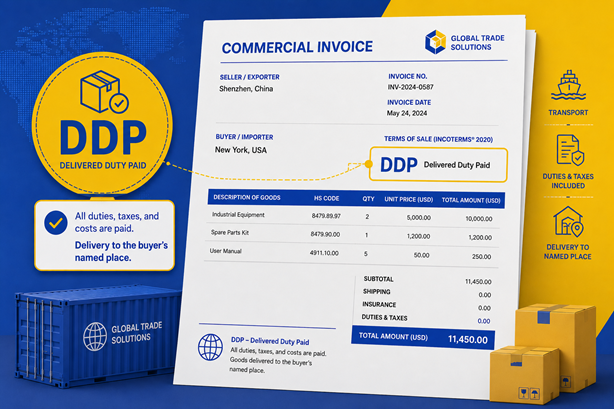
DDP shipping sounds like the easiest way to buy from an overseas supplier. One price including delivery, no freight to arrange, no customs broker to manage, no duty calculations to figure out. The product shows up at your door and the supplier handled everything.
That convenience is real, but DDP terms often carry a legal risk that isn’t always obvious. In recent times, this is especially true when buying from China.
What DDP Shipping Means
DDP stands for Delivered Duty Paid. It is one of the Incoterms, standardized trade terms that define who is responsible for what at each stage of an international shipment. Under DDP, the supplier takes responsibility for everything: export clearance, freight, import customs clearance, duty payment, and final delivery to the buyer’s location.
From the buyer’s perspective, it functions like a domestic purchase. You pay one price and receive product. The supplier manages everything in between.
For that reason, DDP is genuinely useful in certain situations. For straightforward purchases from countries with low tariff exposure, it simplifies the transaction without creating meaningful risk.
As we will detail below, however, it places the responsibility for paying tariffs on the supplier while leaving the legal liability for correctly doing so on you, the importer. That can open you up to real legal troubles, especially in times of high or uncertain tariffs.
The Legal Problem With DDP From China
As the buyer of the goods in the US, you are legally responsible for correctly importing them regardless of the shipping terms used. That doesn’t change just because your supplier arranged the shipment and tariff payments.
As the importer, you are legally responsible for the accuracy of what is declared to US Customs and Border Protection. If the customs value is understated, the wrong tariff rate is applied, or duties are underpaid, the liability is yours, not your supplier’s.
This applies to any country, but it matters especially when buying from China. Ever since the first Trade War, the majority of Chinese products have faced an additional 7.5 to 25 percent tariffs. Combined with the “Liberation Day” tariffs of 2025 (which are now cancelled), many Chinese suppliers and US buyers were looking for ways to skirt these higher costs.
This gave rise to widespread DDP shipping terms from China. Suppliers would offer DDP pricing that somehow didn’t increase to match the tariffs, and many US buyers were happy to turn a blind eye and assume they had no liability because they weren’t the ones directly paying the tariffs.
The reality is that these terms worked by under-declaring the value of goods to US Customs and/or intentionally using the wrong HS code to get lower tariffs.
That is customs fraud. And because CBP doesn’t have jurisdiction over a Chinese supplier, they will go after you, the US buyer, instead. That means it is not just customs fraud, but your customs fraud — regardless of who arranged it.
How CBP Detects Undervaluation
CBP has been aware of this practice since the first trade war and has significantly increased scrutiny of DDP shipments from China in response. The agency uses price benchmarking to compare declared values against known market prices for similar goods. Shipments where declared values fall well below expected market rates are flagged for review.
When undervaluation is found, the consequences can include assessment of back duties on the underpaid amount, substantial fines, cargo seizure, and in serious cases, criminal liability. The fact that your supplier arranged the shipment and told you the duties were handled is not a defense. CBP’s position is straightforward: you are the importer of record and you are responsible for what was declared at the border.
When DDP Is Fine
DDP is not inherently problematic. There are two situations where it can work.
The first is sourcing from countries with low tariff exposure. If the duties on your product are minimal, there is little incentive for a supplier to underreport customs value, and the risk of the arrangement is low.
The second is when your supplier provides full transparency into the duty calculation. If you receive an itemized invoice that shows what was declared as the customs value, which tariff programs were applied, and exactly what was paid to CBP — and those numbers reflect current tariff rates on the correct value of your goods — the arrangement is legitimate
Again, DDP itself is not illegal. The problem is DDP with no visibility into how duties were calculated, at a price that doesn’t add up given what you know about current tariff rates.
The practical test is simple: ask your supplier to show you the duty calculation. A supplier running a clean operation will have no problem providing it. A supplier who can’t or won’t explain how the landed price was achieved is telling you something important.
The Safer Approach
For shipments from China, FOB (Free on Board) is the preferred Incoterm for most importers. Under FOB, the supplier is responsible for getting goods to the port of origin. You arrange freight, work with your own customs broker, and handle the import declaration yourself. Your duty obligations are visible, accurate, and in your hands.
It requires more logistics coordination than DDP, but it keeps your customs compliance clean and eliminates a category of legal risk that has real consequences.
For a full breakdown of how tariffs stack on Chinese goods and what you can expect to pay at the border, see our China Tariffs in 2026: What Every US Importer Needs to Know.
For a broader overview of the import process including Incoterms, customs brokers, and freight forwarders, see our Complete Guide to Sourcing from Asia.
This post is part of our guide US Import Tariffs: A Complete Guide for Importers (2026).