
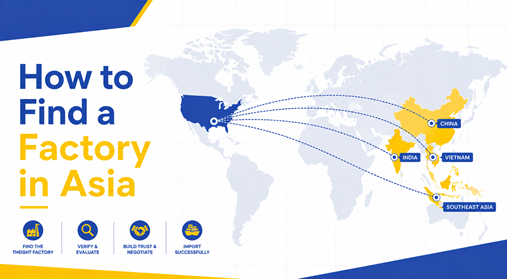
Finding a factory looks easy until you realize how many things can go wrong with the wrong one. Alibaba has thousands of listings. Not all of them are factories. Not all factories are good ones.
Ultimately, finding the right factory for your needs comes down to a mix of proper vetting and good judgment. It comes from asking the right questions, knowing what the answers should look like, and understanding what to do when something doesn’t add up.
This guide covers where to find factories across China, Vietnam, India, and other sourcing destinations, how to tell a legitimate manufacturing operation from a trading company posing as one, what to look for when you’re vetting a new supplier, and the red flags that should make you walk away before you’ve committed any money.
For a broader overview of the sourcing process from start to finish, see our Complete Guide to Sourcing from Asia.
Factory vs. Trading Company
There’s a fundamental distinction worth understanding: not every company that sells you a product makes it.
This is true of brands you buy from in the US, and it’s true of suppliers you will work with overseas.
A factory manufactures the product directly. It has production equipment, a workforce, and a facility where the thing you’re buying is actually made. A trading company is a middleman: it sources from factories and resells to buyers like you, adding its own margin in between. Both exist in large numbers on every sourcing platform, and trading companies routinely present themselves in ways that make them difficult to distinguish from factories.
The difference matters for a few reasons. Factories give you better unit pricing because there’s no middleman margin built in. They also give you more control over production – you can specify materials, adjust processes, and have visibility into what’s actually happening on the floor. Trading companies add a layer of distance between you and the product that becomes more problematic the more quality-sensitive your sourcing is.
That said, trading companies have a legitimate role in certain situations. If your order volume is too small for a factory to deal with directly, a trading company may be your only option for that product. If you need to source multiple product types from a single point of contact, a trading company with broad factory relationships can simplify your supplier management. And in product categories where direct factory relationships are genuinely hard to establish, a trading company with the right connections can be a practical solution.
The goal isn’t to avoid trading companies categorically; it’s to know which one you’re dealing with so you can properly evaluate the relationship.
How to Tell the Difference
One of the most reliable signals is product range. Real factories specialize. They make one category of product, often using one primary material or manufacturing process. A furniture factory makes furniture, a die casting facility makes die cast components, a textile mill makes fabric or finished textile goods.
If a supplier’s catalog spans electronics, furniture, apparel, hardware, and kitchen goods, you’re almost certainly looking at a trading company. If a building materials “manufacturer” makes windows (aluminum and glass), doors (wood), flooring (wood and/or vinyl) and countertops (quartz), they’re a trading company. No single factory has the equipment, workforce, and expertise to manufacture across that range.
You should also ask to see the facility. Request either an in-person visit or a live video tour of the production floor. A factory with genuine manufacturing capability will have no hesitation showing you their equipment, production lines, and workforce in operation.
What you’re looking for is production equipment that matches the product they’re selling you: cutting and sewing machines in a garment factory, injection molding equipment in a plastics factory, metal fabrication machinery in a hardware factory. A supplier who declines a facility visit, offers only a pre-recorded video, or whose “factory tour” shows a warehouse rather than active production lines is telling you something important.
Pay attention to how suppliers answer technical questions about your specific product as well. A factory with genuine production capability answers questions about materials, tooling, lead times, and capacity with confidence and specific detail. A trading company relaying questions to a factory they don’t control will often give vague or delayed answers because they don’t actually know.
Where to Find Factories
There are four main channels for finding factories in Asia: online sourcing platforms, trade shows, referrals, and sourcing partners. Most experienced importers use a combination of all four, depending on the product category and how established their supplier relationships already are.
Online Platforms
Online platforms are the most common starting point, particularly for importers who are new to a product category or sourcing country.
Alibaba is the most widely used platform for international buyers and covers virtually every product category. The supplier directory is enormous, which is both its strength and its limitation. Finding serious factory candidates requires sifting through a large number of listings that include trading companies, resellers, and factories of widely varying quality. Alibaba can be helpful to build a list of candidates, but not to make a final supplier decision.
Global Sources tends to attract more established manufacturers and is particularly strong for electronics, hardware, and industrial products. Supplier verification is more rigorous than Alibaba’s general marketplace, which makes it a useful platform for product categories where technical capability matters.
Made-in-China.com is strong for industrial goods, components, and parts, and offers third-party inspection services that Alibaba does not.
1688.com is the Chinese domestic wholesale platform, the equivalent of Alibaba but designed for Chinese buyers rather than international ones. Because it operates in the local market, prices are typically lower than what you’ll see on Alibaba for the same factories. It operates entirely in Chinese and is designed for domestic transactions, so not all factories will be qualified to produce for export markets.
For Vietnam and other Southeast Asian countries, online platforms are less dominant than they are for China. Sourcing in these markets is more relationship-driven, and the most reliable factory connections typically come through referrals or sourcing partners with established in-country networks rather than platform searches.
For India, IndiaMart is the primary B2B platform and functions similarly to Alibaba: useful for initial discovery, requires thorough vetting before committing to any supplier.
Trade Shows
Meeting suppliers in person changes the quality of information you get. A trade show gives you something no platform listing can: the ability to see samples in person, ask unscripted questions, and get a read on how a supplier presents themselves and handles direct conversation.
The Canton Fair in Guangzhou is the largest sourcing trade show in the world, held twice yearly in spring and fall. It covers thousands of suppliers across virtually every product category and is worth attending if you’re sourcing significant volume or exploring a new product category. The fair is large and requires advance planning: identify which product halls are relevant to you before you arrive and be selective about where you spend your time.
Global Sources trade shows in Hong Kong are strong for electronics and lifestyle products and attract suppliers with more international experience than you’ll typically find at the Canton Fair.
Industry-specific trade shows in the US are also underutilized as a sourcing channel. Suppliers who exhibit at US trade shows are typically more experienced with export compliance, international buyer relationships, and English communication, which makes initial conversations more productive and reduces some of the early vetting work.
Just remember that meeting a supplier at a trade show – whether in Asia or the US – is not a substitute for the vetting process. Even suppliers that come to the US to exhibit at trade shows and represent themselves as manufacturers can be trading companies in disguise.
Referrals
The most reliable way to find a good factory is through someone who already uses one. A referral from a trusted source – an industry contact, a trade association, another importer in an adjacent product category – carries more weight than any platform verification badge because it comes with a track record attached.
If you’re sourcing a product that others in your industry already import, it’s worth asking around before spending time on a platform search. Ask others in your industry if they know of anyone who has sourced similar products and which suppliers they used.
Sourcing Partners
A sourcing partner with established factory relationships in your product category and target country can greatly simplify the process. Their factory relationships are already vetted, their quality track record already established, and their in-country presence means they can visit facilities, conduct audits, and manage supplier relationships in ways that aren’t possible from the US.
For businesses that are new to a sourcing country or product category, finding and qualifying the right factory is often the hardest part of getting started, and the part most likely to result in an expensive mistake if rushed. A sourcing partner handles that work as part of the service: identifying factory candidates, conducting facility visits and audits, evaluating production capability against your specific requirements, and developing the supplier relationship before your first order is placed.
For brands and manufacturers who are already producing in Asia and need on-the-ground support, a sourcing partner with in-country presence serves as your eyes and ears at the factory – managing the supplier relationship, overseeing production, and catching problems while they’re still fixable rather than after the shipment has left the country.
For businesses that want to hand off the entire process, from factory identification through importing and delivery, a full-service procurement partner manages everything end to end, so your team isn’t pulled into the logistics of running an overseas supply chain.
How to Vet a Factory Before You Commit
Finding factory candidates is the easy part. Determining whether they’re actually capable of producing your product at the quality and consistency you need is where the real work happens. Most sourcing problems – late deliveries, quality failures, miscommunications about specifications – trace back to inadequate vetting before the first order was placed.
Here is what that vetting process should cover.
Confirm They Actually Make What You Need
Start with the product range test from Section 1. If their catalog is narrow and focused on a single product category, that’s a good sign. If it spans unrelated categories and material types, dig deeper before proceeding.
Then get specific. Ask how long they have been making this particular product. Ask what their monthly production capacity is. Ask what materials they use and where they source them. Ask whether they have produced this product for US buyers before and whether there are compliance or certification requirements they are familiar with. The answers to these questions tell you quickly whether you’re talking to someone who actually makes what you need or someone who is figuring it out as they go.
Request a Facility Visit or Live Video Tour
Any serious factory will welcome the opportunity to show you their operation. If you can visit in person, do so. If not, request a live video call with a walk-through of the production floor. Not a pre-recorded promotional video, but a live tour where you can ask to see specific equipment and areas of the facility.
What you’re looking for is a production environment that matches the product. Active machinery, a workforce that appears to be doing the work your product requires, raw materials and work-in-progress inventory that correspond to what they claim to make. A facility that looks more like a warehouse or a showroom than a production floor is a red flag regardless of what their listing says.
Ideally, you will also want to professionally audit any factories on your shortlist. A full audit will cover everything from factory cleanliness and workforce evaluation to QA processes and test equipment. There are 3rd-party companies out there that offer this service, and a sourcing/procurement company you work with will usually be able to do this as well.
Understand Their Export Experience
A factory that has been exporting to the US for years understands labeling requirements, documentation, and the expectations of American buyers in ways that a factory new to export markets does not. They will be familiar with US compliance requirements, labeling needs, and product standards.
Especially if you are buying a relatively standard product, like building materials, foodservice disposables, or CPG goods for resale, they should already have compliance and testing certificates ready to show you. If you are building something custom, they should know which 3rd party testing labs to use when the time comes to get your product certified.
Start With a Sample Order, Not a Full Production Run
No amount of vetting replaces seeing what a factory actually produces. Before committing to a full production order, go through the sampling process. A pre-production sample built to your specification tells you whether the factory can execute what you need. A production sample pulled from the beginning of the actual run tells you whether they can do it consistently.
The sampling process takes time. It is also the most reliable quality control tool available to you before money is committed to a full order.
For more on how the sampling process works and what to look for at each stage, see our post How Product Sampling Works coming soon.
Red Flags to Watch For
Prices significantly below comparable factories. Anyone can be tempted by a quote that comes in dramatically lower than everyone else. It almost never means you found a better deal. It usually means the supplier is planning to use cheaper materials than specified, cut corners during production, or isn’t actually capable of making the product and will figure that out after you’ve paid a deposit. When a price doesn’t make sense given what you know about material and labor costs, ask for a detailed cost breakdown. How they respond tells you a lot.
Evasiveness about a facility visit or live tour. A factory with nothing to hide shows you their facility. Excuses about timing, ongoing production, or company policy around visitors are not legitimate reasons to deny a serious buyer a look at the operation. If a supplier won’t show you where and how your product is made, move on.
A catalog that spans unrelated product categories. As covered in Section 1, real factories specialize. A supplier offering products across multiple unrelated categories and material types is almost certainly a trading company, regardless of how they describe themselves.
Communication only through a personal mobile number. Legitimate manufacturing operations have business email addresses, company websites, and verifiable business information. A supplier who communicates exclusively through a personal WhatsApp number or mobile contact with no traceable business presence is a risk not worth taking.
Samples that look great but production quality drops. This is one of the most common and costly patterns in overseas sourcing. A supplier sends a beautiful sample (often made with extra care and better materials than they intend to use in production) and the actual production run comes in at a noticeably lower quality. This is why production samples pulled from the actual run matter, and why QC during production matters more than a pre-shipment inspection alone.
Pressure for full payment upfront. Standard payment terms in overseas manufacturing involve a deposit, usually 30 percent, with the balance paid against documents before shipment or upon delivery. A supplier pushing for full payment before production begins, before samples are approved, or before any trust has been established is a significant red flag. Established factories with real order flow don’t need to collect full payment upfront from new customers.
Vague or delayed answers to technical questions. A factory that makes your product knows how it’s made. If technical questions about materials, tolerances, production processes, or lead times consistently produce vague answers or long delays, the supplier either doesn’t make what they say they make or doesn’t understand your requirements well enough to execute them.
First Contact and What to Send
Once you have a list of factory candidates, how you make first contact matters more than most importers realize. Factories receive a high volume of inquiries, many of them vague and from buyers who never place an order. A well-structured first message signals that you’re a serious buyer and gets you a faster, more substantive response.
Your first message should be short and specific. Introduce your company in one or two sentences, describe the product you’re sourcing with enough detail that the supplier can confirm whether they make it, state your approximate target volume, and ask one specific question that demonstrates you’ve thought seriously about the product. You’re not sending your full specification at this stage, you’re establishing that you’re worth responding to.
Avoid generic opening messages like “I am interested in your products, please send me your catalog and price list.” Every factory receives dozens of these. They tell the supplier nothing about what you need or whether you’re a serious buyer, and they typically produce a generic response that tells you nothing useful in return.
Once you’ve had an initial exchange and confirmed the supplier makes what you need, follow up with a formal Request for Quote (RFQ). Your RFQ should include your complete product specification, a request for unit pricing at two or three volume tiers, tooling costs if applicable, lead time from deposit to shipment, MOQ, and payment terms. Sending a thorough RFQ does two things: it gives you the information you need to make a meaningful comparison between suppliers, and it signals to the factory that you know what you’re doing.
Get quotes from at least three factories before making any decisions. Pricing, lead times, MOQ, and communication quality all vary significantly between suppliers, and you won’t have a useful basis for evaluation until you’ve seen the range.
Vietnam, India, and Other Sourcing Countries
Everything covered in this guide applies across sourcing countries: the vetting principles, the red flags, the importance of seeing the facility, and the value of referrals are consistent regardless of where you’re sourcing. What changes is how you find factory candidates in the first place.
China has the most developed online sourcing infrastructure of any manufacturing country. Alibaba, Global Sources, and Made-in-China.com give international buyers direct access to a large number of Chinese suppliers from anywhere in the world. That infrastructure doesn’t exist at the same scale in other sourcing countries.
In Vietnam, factory discovery is more relationship-driven. There is no Vietnamese equivalent of Alibaba with broad international reach. The most reliable path to qualified Vietnamese factories is through referrals from others who are already sourcing there, or through a sourcing partner with established in-country factory relationships. Attempting to find Vietnamese factories through cold platform searches produces thinner and less reliable results than the same approach in China.
India’s primary B2B platform is IndiaMart, which functions similarly to Alibaba and is worth searching for initial discovery. Indian manufacturers are also active on global platforms including Alibaba and Global Sources. As with China, platform discovery is a starting point rather than a vetting process — the same factory qualification steps apply regardless of how you found the supplier.
For Cambodia, Bangladesh, Indonesia, Thailand, and other Southeast Asian sourcing countries, on-the-ground relationships matter most. These markets have less developed online sourcing infrastructure than China or India, and the factories most capable of producing for international buyers are often not well represented on global platforms. A sourcing partner with regional coverage and existing factory relationships is the most practical path to qualified suppliers in these markets.
The broader point is that the further you go from China in your sourcing geography, the more valuable in-country presence and established relationships become relative to platform-based discovery. It’s one of the reasons multi-country sourcing programs benefit from a partner who operates across the region rather than managing each country independently from the US.
For how tariff exposure varies by sourcing country, see our US Import Tariffs: Complete Guide.
Good Factories Don't Find Themselves
Finding a good factory in Asia is not a one-step process. It takes research, direct communication, careful vetting, and in most cases several rounds of sampling before you have a supplier you can rely on. Done well, it’s the foundation of a sourcing program that runs smoothly for years. Done poorly, it’s the source of most of the quality problems, delivery failures, and financial losses that give overseas sourcing a bad reputation.
First Link has established factory relationships across China, Vietnam, India, and Southeast Asia, built through years of on-the-ground sourcing work. Whether you need a partner to find and qualify factories for a new product, on-the-ground support at a factory where you’re already producing, or a full-service procurement program that handles everything from supplier identification through delivery, we work with the kind of factories that make sourcing from Asia what it’s supposed to be: reliable, cost-effective, and worth the effort.
If you’re starting a new sourcing program or looking to qualify suppliers in a new country, we’d be glad to help.
This post is part of our Complete Guide to Sourcing from Asia.